What is Peppol? A practical guide for Luxembourg businesses
Peppol explained for Luxembourg: how the network works, what Bill 8815 changes, the 2028 and 2029 deadlines, and how to get your business ready.
Posted by
 Faktura Team
Related reading
Luxembourg reverse charge without proof: the VIES record your invoicing software throws away
Why qualified VIES consultation records matter for Luxembourg reverse-charge invoices and long-term audit evidence.
The Future of Invoicing and VAT in Luxembourg in 2026
A guide for managers, fiduciaries, and IT decision-makers in the Grand Duchy
If you run a business in Luxembourg, Peppol is about to stop being something only public-sector suppliers worry about. Under Bill 8815, tabled in the Chamber of Deputies on 30 July 2026, every Luxembourg business will have to be able to receive structured e-invoices from 1 January 2028, and the draft Grand-Ducal regulation accompanying the bill confirms that those invoices will travel over Peppol.
This guide explains what Peppol actually is, how it carries an invoice from your software to your client's, what the Luxembourg timeline looks like, and what you can do now to prepare your business activity for upcoming electronic invoicing regulations in Luxembourg.
What is Peppol?
Peppol is an international network and set of standards that lets businesses and public bodies exchange structured electronic documents, invoices first among them, whatever software each side happens to use. The name originally stood for Pan-European Public Procurement Online, a reminder that it started as an EU project to digitise public purchasing. Today it is run by OpenPeppol, a non-profit association, and it is used well beyond Europe.
The simplest way to picture Peppol is as email for invoices, with two important differences. What travels is not a PDF but a machine-readable file whose fields (supplier, VAT numbers, line items, totals, VAT breakdown) your client's accounting system can import without anyone retyping them. And you cannot send to just any address: every sender and receiver is registered, every message is validated, and only certified providers are allowed to carry the traffic.
How Peppol works: the four-corner model
Peppol is built on what is called the four-corner model. Corner one is you, the supplier, issuing the invoice from your invoicing or accounting software. Corner two is your access point, a certified service provider that connects your software to the network, while corner three is your client's access point and corner four is your client's own software, where the invoice finally lands.
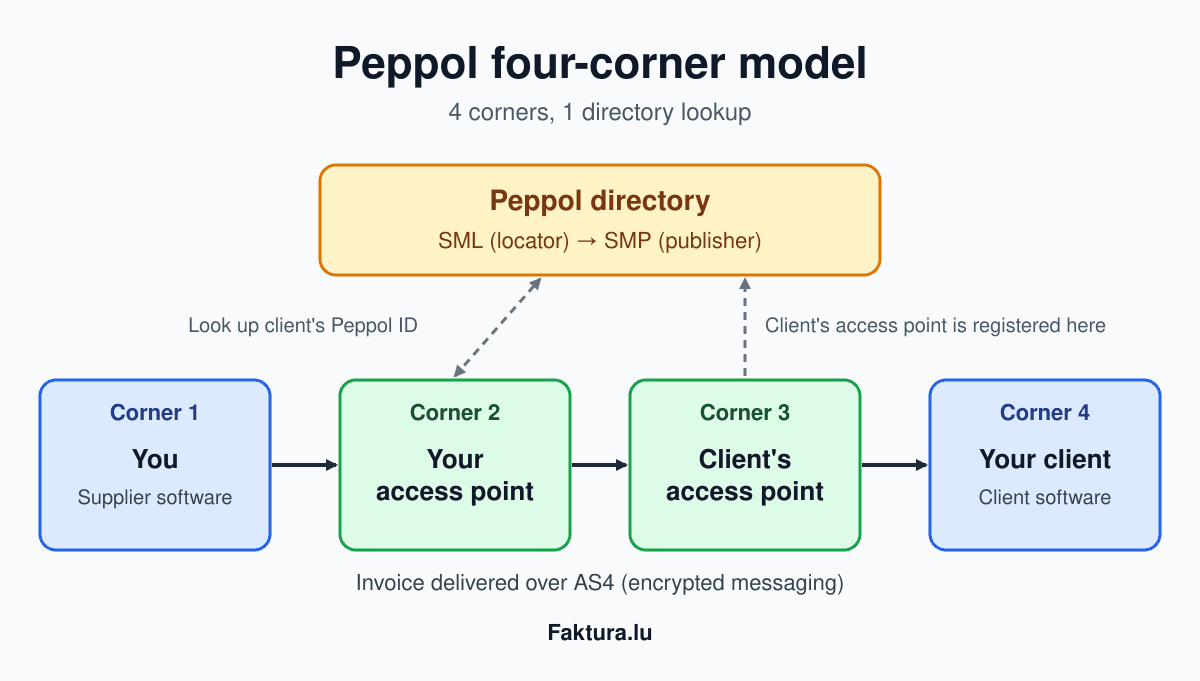
When you send an invoice, your access point looks up your client's Peppol identifier in a two-level directory. The SML (Service Metadata Locator) works much like DNS and points to the right SMP (Service Metadata Publisher), which in turn says which access point serves your client and which document types they can receive. Your access point then delivers the invoice to theirs over AS4, an encrypted messaging protocol, and theirs passes it on to your client's system.
The practical consequence is that you only ever connect once. You do not need to know which software your clients use, and either side can change provider without breaking anything, in the same way that switching email provider does not stop people from writing to you. In most cases, you will never deal with an access point directly because your invoicing software either runs one or partners with one.
Peppol in Luxembourg: public sector today, B2B from 2028
Luxembourg is not new to Peppol. The law of 16 May 2019 on electronic invoicing made structured e-invoices mandatory for suppliers to the State, the communes and other public bodies, and that obligation has run over Peppol since 2022. If you have ever invoiced a ministry or a commune, your business may already have a Peppol identifier without you realising it.
What changes now is the private sector. The Government Council approved a draft law on 17 July 2026 extending mandatory e-invoicing to domestic business-to-business transactions, and it was tabled as Bill 8815 on 30 July. The bill itself only refers to a common delivery network, but the draft Grand-Ducal regulation that goes with it names Peppol, so the infrastructure already used for public procurement simply extends to invoices between companies.
Luxembourg is following the path Belgium took, where Peppol started with public procurement and became mandatory for all domestic B2B invoices on 1 January 2026. Unlike France, Luxembourg is not proposing a real-time e-reporting obligation for now: the reform changes how invoices are exchanged, not how they are reported to the AED.
Luxembourg Peppol deadlines and who is in scope
The obligation to receive comes first and applies to everyone at once; the obligation to issue follows in two waves depending on company size.
| Date | Who | Obligation |
|---|---|---|
| 1 January 2028 | All Luxembourg-established businesses in scope | Be able to receive and process structured e-invoices |
| 1 July 2028 | Large and medium-sized businesses | Issue structured e-invoices to Luxembourg business clients |
| 1 January 2029 | All other businesses | Issue structured e-invoices to Luxembourg business clients |
Company size is assessed on the 2026 financial statements, by reference to a balance sheet total of EUR 7.5 million, net turnover of EUR 15 million and 50 full-time employees. If you are a freelancer or a small company invoicing other Luxembourg businesses, your issuing deadline is therefore January 2029, but you will need to receive Peppol invoices a full year earlier.
The mandate covers invoices between two taxable persons established in Luxembourg, for supplies taxed in Luxembourg. Invoices to private individuals stay outside it, as do cross-border invoices, which fall under the EU's VAT in the Digital Age (ViDA) rules from 1 July 2030, and certain VAT-exempt financial and insurance services. Credit notes follow the same rules as the invoices they correct.
The bill also plans softer routes for businesses with little volume: a manual issuing tool, temporary reception solutions during 2028, and a permanent de minimis regime for companies that issue only a small number of invoices that fall within the scope. The thresholds for that regime will be set by Grand-Ducal regulation and are not known yet.
Keep in mind that the bill still has to go through the Council of State and the professional chambers, so dates and scope may still move before adoption; we cover the legislative detail in our article on the Luxembourg e-invoicing law.
What counts as a Peppol e-invoice (and what does not)
A Peppol invoice is an XML file following Peppol BIS Billing 3.0, the Peppol implementation of the European e-invoicing standard EN 16931. Every mandatory invoice mention is carried as structured data, which is what allows the software on the other side to validate and book it without human input.
That rules out most of what people call e-invoices today. A PDF sent by email is not one, even when your software generated it, and neither is a scan or a PDF uploaded to a client portal. Under the bill, only the structured invoice has legal value: you can still attach a PDF copy for your client's convenience, but that attachment is no longer the invoice.
One more change is easy to miss. Today a Luxembourg client has to agree to receive electronic invoices; once the mandate applies, that consent is no longer needed between Luxembourg businesses, and a client can no longer refuse an invoice simply because it arrived in structured form.
How to get your business ready for Peppol
The network and the standard are already known, so there is no reason to wait for the final text before preparing.
- Check whether you are already registered. Search your company name or VAT number in the public Peppol Directory; if you have invoiced the public sector, you may already be there.
- Ask your invoicing software the right question. "Do you do e-invoicing?" is not enough, since many tools call a PDF export e-invoicing. Ask whether they send and receive over Peppol, through which access point, and whether incoming invoices land in the same place as your outgoing ones (as planned on our pricing roadmap).
- Clean up your client data. Structured invoices are validated automatically, so missing or wrong VAT numbers, addresses and references that a human would forgive will cause rejections.
- Plan for receiving before issuing. January 2028 concerns incoming invoices for everyone, so decide now who in your company, or at your fiduciaire, handle supplier invoices arriving through Peppol.
- Talk to your fiduciaire. If they keep your books, agree on how Peppol invoices will reach them, whether by access to your software or by export, so that your gains of automatic invoicing aren't lost over manual operations towards or from your fiduciaire.
Peppol FAQ
Is Peppol mandatory in Luxembourg?
Today it is mandatory only for invoices to the public sector. Under Bill 8815, every in-scope Luxembourg business will have to receive Peppol invoices from 1 January 2028 and issue them from July 2028 or January 2029, depending on its size.
Do I need my own Peppol access point?
No. Access points are run by certified providers, and you reach the network through invoicing or accounting software that operates or partners with one.
What is a Peppol ID?
It is your address on the network, made of a code for the identification scheme followed by the identifier itself, often your VAT number. Your provider registers it for you, and anyone can look it up in the Peppol Directory.
Can I still send PDF invoices?
To private individuals, yes. To Luxembourg business clients, a PDF will no longer count as the invoice once your issuing deadline applies, although you can still attach one to the structured invoice.
Does Peppol apply to invoices to other EU countries?
Not under the Luxembourg bill, which only covers domestic transactions. Cross-border B2B invoices within the EU will move to structured e-invoicing under ViDA from 1 July 2030, and in the meantime your existing rules, including reverse charge, still apply.
Is Peppol secure?
Yes. Only certified providers can join the network, messages between access points are encrypted, and each participant is identified, which makes Peppol far harder to abuse for invoice fraud than email.
Peppol is coming either way: get ready today
Peppol is not a new tax or a new declaration; it is a better pipe for something you already do every month. The businesses that will feel 2028 are the ones still typing invoices into Word or juggling PDFs by email, while those whose software already speaks Peppol will barely notice the switch.
Faktura was built for Luxembourg invoicing from day one, and Peppol sending and receiving is on its way, well ahead of the 2028 deadline. Start your free trial today, and your invoicing will already be in the right place when the switch comes.

