Luxembourg reverse charge without proof: the VIES record your invoicing software throws away
Why qualified VIES consultation records matter for Luxembourg reverse-charge invoices and long-term audit evidence.
Posted by
 Faktura Team
Related reading
The Future of Invoicing and VAT in Luxembourg in 2026
A guide for managers, fiduciaries, and IT decision-makers in the Grand Duchy
What Faktura shows when VIES comes back with a clear no: a visible warning, and VAT charged by default until proof says otherwise.
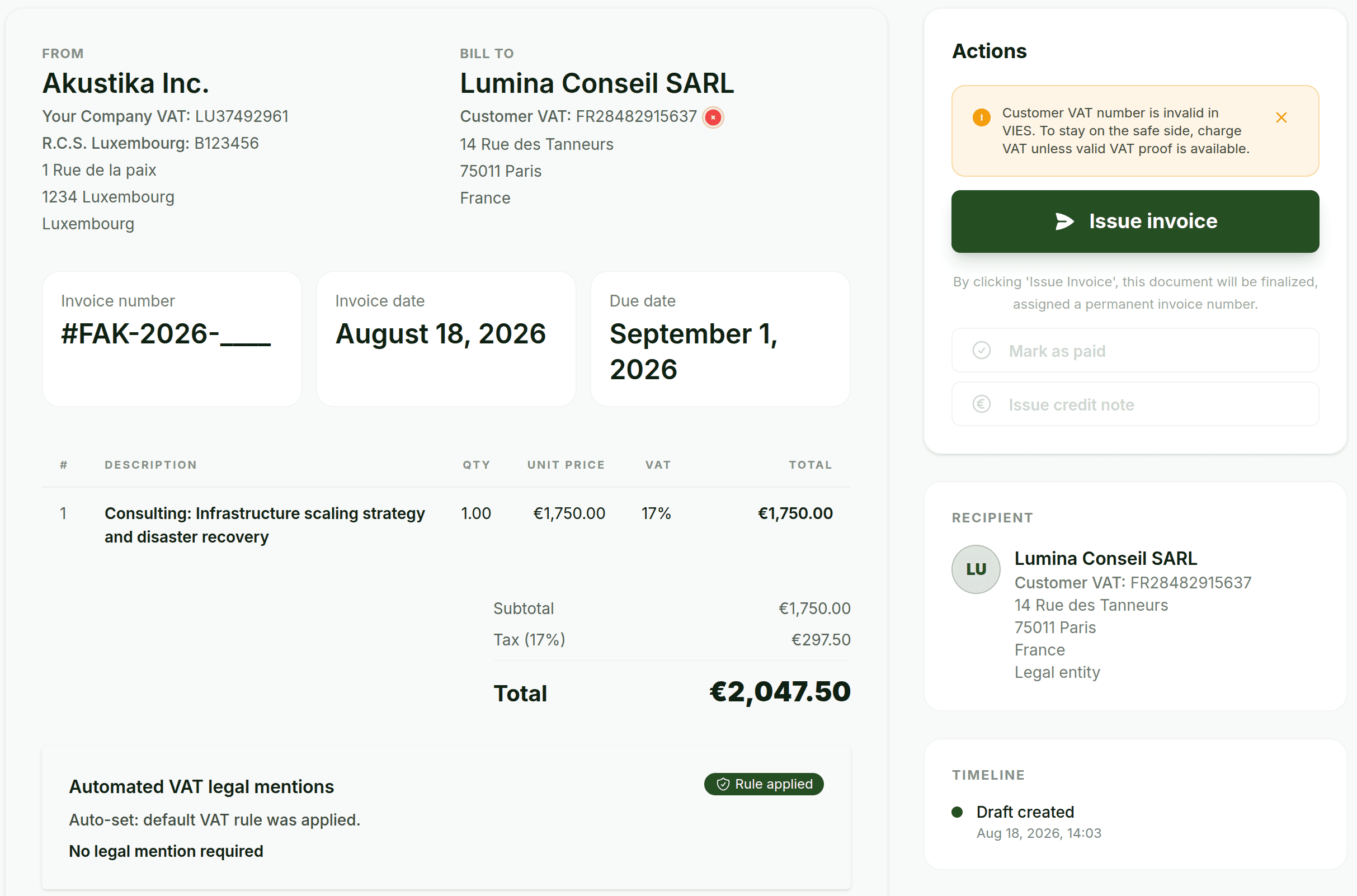
If you run a company out of Luxembourg then you have probably already used, or at least heard of, VIES - the VAT Information Exchange System. It's the free online search tool developed and maintained by the European Commission. You can verify whether your customer's VAT number is correct and eligible for invoicing, free of charge.
VIES also provides means to technically integrate with other applications, and most generic invoicing software on the market integrates this verification in some form. Few, however, explain what happens to the result of a qualified VIES request after the check itself.
What the reverse charge actually requires you to prove
In Luxembourg, the AED can require you to prove that a reverse charge invoice was issued on good grounds. That means your client is a registered business in another EU country, and that you either supplied a service under Article 44 with customer liability under Article 196, or sold goods exempt as an intra-Community supply under Article 138 of EU VAT Directive 2006/112/EC.
A valid VAT number is the baseline, not the finish line. Years later, when an audit question comes in, the key question is not only what appears on the invoice, but why you were confident enough to apply reverse charge at issuance time.
What VIES actually returns, and what software often throws away
A simple request returns valid/invalid. A qualified request includes your own VAT as requester and, when successful, VIES returns a consultation number (`requestIdentifier`). That reference is the Commission-side identifier that you specifically ran that check on that date and got that result.
Many tools only keep the boolean status and display a green indicator. The consultation identifier and response details are often discarded once the check completes.
A validation is not a record
A VIES check tells you what was true when you asked. It does not create long-term evidence by itself, and VAT status can change later. The European Commission's own guidance recommends retaining proof of each validation for audit purposes.
A screenshot is weak evidence. A consultation number is stronger because it is issued by VIES at check time. It is not cryptographically signed, but it is still a contemporaneous machine-generated record rather than something reconstructed after the fact.
What an audit-grade VIES record should contain
- The VAT number that was checked
- Your own VAT number as requester
- The consultation number returned by VIES
- The exact date and time of the check, to the second
- The validity result
- The name and address returned by VIES, if any
- The invoice the check backs
- How long the record is retained
Logging is only half the job. If you cannot retrieve the record on demand years later, the check happened but remains practically unprovable.
How Faktura records the VIES check
In Faktura, reverse charge issuance uses a qualified request under your own company VAT number, not a shared generic requester. The record is tied directly to the issued invoice, written at issuance, and protected from update/deletion at database level.
The stored record captures the checked number, requester number, consultation number, timestamp, result, returned name/address, and invoice linkage so the evidence remains usable when needed.
A few things worth knowing
What if my customer's VAT number is cancelled after I invoice them?
The earlier invoice does not change retroactively. The evidence reflects what was true at check time. For future invoices, re-checking still matters, and Faktura performs that verification automatically.
What if VIES is unavailable when I issue the invoice?
VIES depends on member-state systems that may go offline. Faktura records the outage context and supports follow-up verification rather than pretending a successful validation happened.
Do I need a new check for every invoice?
Each invoice run triggers verification logic. If another check for the same requester and target happened moments earlier, the result may be reused to avoid redundant upstream calls, while still retaining timestamped evidence of when the underlying check occurred.
Reverse charge itself is not made more complex by this. What changes is the audit position years later: instead of only an invoice and mention, you have a dated record tied to that exact invoice showing what was checked and when.

